Sun Dogs Explained: Understanding the Parhelion Phenomenon
What is a Sun Dog (Parhelion)?
A sun dog, scientifically known as a parhelion (plural: parhelia), is a stunning atmospheric optical phenomenon characterized by a bright spot of light appearing on either side of the Sun. These luminous patches often occur on or near the 22° halo, a ring of light that encircles the Sun. Sun dogs are frequently mistaken for mock suns due to their brilliance and sometimes curved appearance, which mirrors the halo itself.
These celestial displays are not always subtle; at times, they can be intensely bright, with one parhelion potentially being more pronounced than the other. While they can appear colorful, akin to a rainbow, their hues are typically more muted, with a distinct reddish tint on the side closest to the Sun and a bluish hue on the outer edge. The phenomenon is often observed when the Sun is low on the horizon, typically during sunrise or sunset, and can be seen globally, regardless of season, as the necessary ice crystal clouds form at high altitudes where temperatures are consistently low.
The Science Behind Sun Dogs: Formation and Characteristics
The formation of parhelia is a direct result of the interaction between sunlight and hexagonal ice crystals suspended in the Earth's atmosphere. These plate-shaped crystals, predominantly found in high-altitude cirrus or cirrostratus clouds, act as natural prisms. As sunlight passes through these crystals, it undergoes refraction, bending the light rays with a minimum deflection angle of 22°.
When these ice crystals drift with their broad, hexagonal faces oriented nearly horizontally, they refract sunlight parallel to the horizon, thereby creating the visible bright spots on either side of the Sun – the parhelia. The intensity and size of the parhelia can vary; larger, wobbling crystals tend to produce taller sun dogs. The coloration observed in sun dogs, ranging from red to blue, arises from the dispersion of light as it's refracted. The colors are generally muted and overlap, blending into the white of the parhelic circle or halo, if visible.
Conditions Favoring Sun Dog Visibility
While ice crystal clouds can exist year-round at high altitudes, the visibility of sun dogs is particularly enhanced under specific conditions. They are most conspicuous and easily observed when the Sun is near the horizon. This preference for a lower solar altitude makes them a more common sight in higher latitudes and mid-latitudes during the winter months when the Sun naturally sits lower in the sky.
Although parhelia are a global phenomenon, their intensity and clarity depend on the precise orientation and concentration of ice crystals. Even on days with widespread cirrus clouds, the specific alignment required for refraction might not occur, leading to their absence or faintness. Conversely, under ideal conditions, sun dogs can be exceptionally bright, earning them the nickname 'mock suns'.
Beyond Sun Dogs: Related Atmospheric Optical Phenomena
Sun dogs are part of a broader family of halo phenomena, all caused by the refraction and reflection of light by ice crystals. The 22° halo, a ring of light around the Sun at an angular distance of 22 degrees, frequently accompanies parhelia and appears to interconnect them. This halo forms due to the same plate-shaped ice crystals responsible for creating sun dogs.
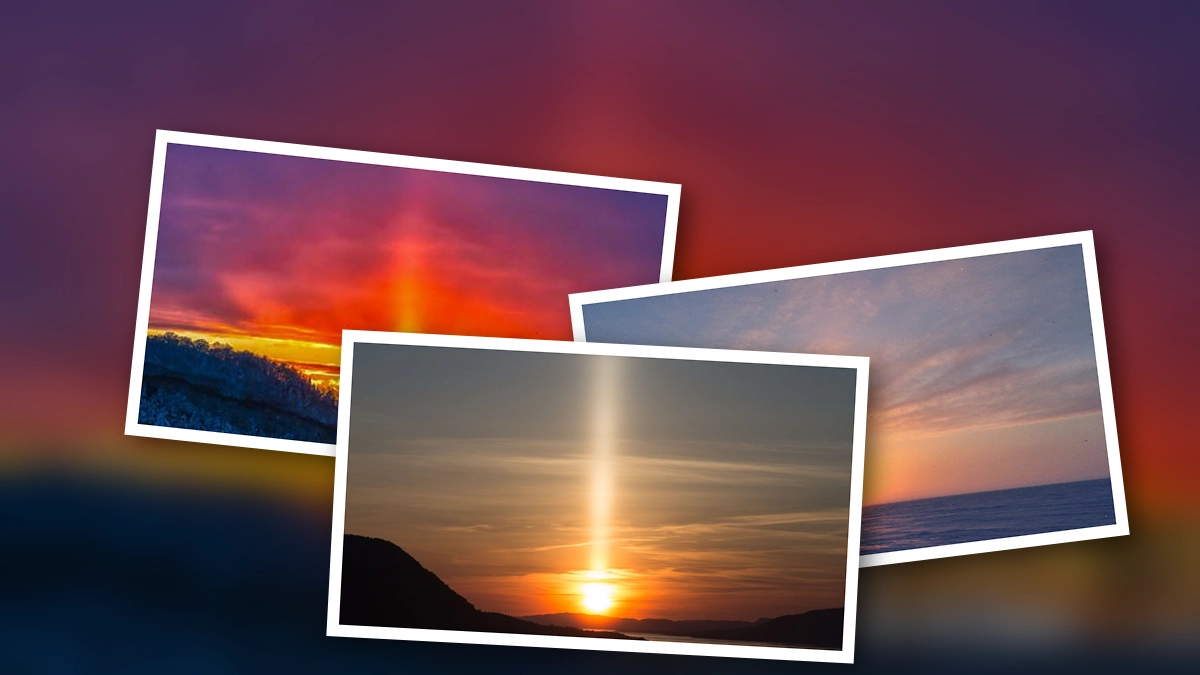
Other related phenomena include the sun pillar, a vertical shaft of light extending above or below the Sun, which is caused by the reflection of light off the horizontal faces of falling ice crystals. Additionally, the circumzenithal arc, a vivid arc of color appearing high in the sky, often co-occurs with parhelia, as both are generated by the same type of ice crystal. While less common, similar phenomena can occur with moonlight, known as paraselene.
Historical Observations and Cultural Significance
The striking appearance of sun dogs has captivated observers for centuries, leading to their documentation throughout history. The term 'parhelion' itself is derived from the Greek words 'para' (beside) and 'helios' (Sun), directly referencing its position relative to the Sun. The nickname 'sun dog' also has ancient Greek roots, likely stemming from the visual impression of these bright spots 'following' the Sun, much like a canine companion.
These natural spectacles have been noted in various cultures, often interpreted through myth and legend. While scientific understanding has demystified their formation, the visual splendor of sun dogs continues to evoke a sense of wonder and awe, reminding us of the intricate beauty of atmospheric optics.
Key takeaways about sun dogs
- Sun dogs (parhelia) are bright spots of light seen beside the Sun, often forming part of a 22° halo.
- They are caused by the refraction of sunlight through hexagonal ice crystals in the atmosphere.
- Parhelia typically appear at the same altitude as the Sun and are most visible when the Sun is low on the horizon.
- Colors are usually muted, with red closest to the Sun and blue on the outer edge.
- Related phenomena include sun pillars and the circumzenithal arc.
 20/07/2026