Understanding Red Sprites and Blue Jets: Transient Luminous Events
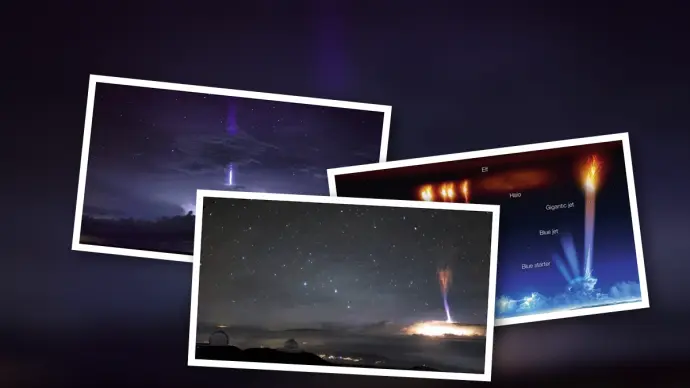
High above the familiar world of thunderstorms, a spectacular display of electrical activity unfolds in the upper atmosphere. These ethereal events, known as Transient Luminous Events (TLEs), include the mesmerizing red sprites and the elusive blue jets. While often challenging to observe due to their fleeting nature, these phenomena offer a unique glimpse into the complex electrical processes connecting the Earth's surface to the ionosphere. This article delves into the nature, science, and visual characteristics of red sprites and blue jets, bringing these captivating atmospheric events into focus.
Key Takeaways on Red Sprites and Blue Jets
- Red Sprites: Large-scale electrical discharges in the mesosphere, typically triggered by positive lightning strikes.
- Blue Jets: Narrower, more conical electrical discharges originating from the cloud tops, extending towards the ionosphere.
- Transient Luminous Events (TLEs): A family of upper-atmospheric lightning-related phenomena.
- Occurrence: Estimated at 500,000 red sprite occurrences per year, about one per minute globally.
- Appearance: Sprites are red-orange, jets are blue, often appearing as intricate, fast-moving shapes.
What are Red Sprites and Blue Jets?
Red sprites and blue jets are two of the most well-known types of Transient Luminous Events (TLEs). They are distinct from conventional lightning, occurring significantly higher in the atmosphere and possessing unique visual characteristics and formation mechanisms. Understanding red sprites and blue jets requires appreciating the electrical dynamics of thunderstorms and the atmospheric layers they inhabit.
Red Sprites Explained
Red sprites are vast electrical discharges that emerge from the tops of powerful thunderstorms and reach into the mesosphere, an atmospheric layer located roughly 50 to 85 kilometers above the Earth's surface. They are characterized by their distinctive red or orange hue. These events are not direct lightning strikes but rather secondary phenomena, resulting from the enormous electrical impulse generated by lightning below.
The formation of red sprites is intricately linked to the aftermath of powerful positive cloud-to-ground lightning strikes. When such a strike transfers a significant amount of positive charge to the ground, the cumulonimbus cloud is left with a substantial net negative charge. Conversely, the overlying ionosphere carries a net positive charge. This charge separation creates a strong, albeit short-lived, electric field in the region above the thunderstorm. In the tenuous atmosphere of the upper mesosphere, where air pressure is extremely low, the dielectric breakdown voltage is significantly reduced. This allows for an electron avalanche effect to occur, initiating the luminous discharge that we observe as a red sprite.
Blue Jets Unveiled
Blue jets are another fascinating type of TLE, often appearing alongside red sprites. Unlike sprites, blue jets are typically observed originating from the thundercloud's core and propagating upwards in a more focused, conical shape towards the edge of space. Their coloration is distinctly blue, a difference attributed to the atmospheric conditions and excitation mechanisms involved.
The science behind blue jets suggests they are also electrical discharges, but their precise triggering mechanisms and pathways differ from sprites. Some theories propose they are related to the intense electric fields within the thundercloud itself, or perhaps a different type of charge transfer associated with lightning. Their journey is generally shorter and more directed than the expansive reach of red sprites.
The Science Behind Transient Luminous Events
The study of red sprites and blue jets has evolved significantly with advancements in atmospheric physics and observational technology. While red sprites and blue jets are the most commonly discussed, the family of Transient Luminous Events also includes phenomena like elves (emissions of light and very low frequency perturbations due to electromagnetic radiation from lightning) and terrestrial gamma-ray flashes (TGFs).
Formation and Triggers
The 99% statistic for red sprites being triggered by positive lightning strikes highlights a crucial aspect of their formation. These are not random events but are directly consequential to the immense electrical power of thunderstorms. The electric field strength required to initiate these upper-atmospheric discharges is substantial, necessitating the significant charge redistribution caused by major lightning events.
The low-pressure environment of the mesosphere plays a critical role. At altitudes around 80 km, the air is so thin that electrons can accelerate to high energies between collisions, leading to ionization and excitation of atmospheric gases. Nitrogen, the primary component of Earth's atmosphere, is responsible for the characteristic colors: in the upper mesosphere at low pressures, nitrogen emissions dominate, producing the red hue of sprites. As atmospheric pressure increases at lower altitudes, collisions become more frequent, 'quenching' the red emissions and favoring bluer emissions, as observed in blue jets or the lower portions of some sprites.
Observational Challenges
Observing red sprites and blue jets presents significant challenges. They occur at high altitudes, are extremely brief in duration, and often appear visually faint or are obscured by the intense lightning activity below. Early observations were often dismissed as optical illusions or misidentifications. However, advancements in high-speed cameras and sensitive light detectors have enabled scientists to capture these elusive phenomena, leading to a deeper understanding of their characteristics.
The ISUAL (Imager of sprites and lightning) satellite, for instance, has provided invaluable data, estimating around 500,000 red sprite occurrences annually. This suggests that approximately one sprite happens every minute somewhere on Earth, underscoring their prevalence despite their difficulty to witness.
The Visual Appearance of Sprites and Jets
The visual manifestation of red sprites and blue jets in the night sky is quite distinct and captivating. Their appearance can vary, but common characteristics have been identified through numerous observations and photographic records.
Color and Form
Sprites typically appear as luminous red-orange flashes. They can manifest in various intricate shapes, often described as resembling jellyfish, carrots, or branching structures. Their ephemeral nature means they flicker and change form rapidly, making them a mesmerizing sight for those fortunate enough to observe them.
Blue jets, on the other hand, are characterized by their blue coloration and their more directed, jet-like trajectory. They often appear as narrow cones or columns of light shooting upwards from the thundercloud. While sprites are more diffuse and spread out, blue jets are typically more compact and linear.
Speed and Brightness
Both phenomena are incredibly fast. Sprites can last mere milliseconds, and their intricate formations can evolve within fractions of a second. This speed is a major reason why they are so difficult to discern with the naked eye, often appearing as a quick, faint white flash from a distance, especially under less-than-ideal viewing conditions.
The brightness of these events is also variable. While they are luminous, they are significantly dimmer than terrestrial lightning. This, combined with their high altitude, means they are best observed from dark locations, away from light pollution, and when strong thunderstorms are present in the distance.
Comparing Red Sprites, Blue Jets, and Other TLEs
The world of Transient Luminous Events is diverse, with red sprites and blue jets being just two members of a fascinating family. Each TLE has its unique characteristics and formation pathways.
| Event Type | Altitude Range (approx.) | Primary Color | Typical Formation Trigger | Visual Appearance |
|---|---|---|---|---|
| Red Sprite | 50-90 km | Red/Orange | Positive lightning (cloud-to-ground) | Jellyfish, carrot, or branching shapes; diffuse |
| Blue Jet | 20-50 km | Blue | Intracloud or cloud-to-ground lightning (less clear) | Conical, jet-like beams originating from cloud top |
| Elf | >90 km | Faint Reddish-white | Very large lightning discharges (cloud-to-ground) | Expanding ring or disk of ionization, often brief |
These TLEs serve as indicators of the immense electrical activity occurring in our atmosphere, demonstrating that lightning is not confined to the familiar channels within or between clouds.
Conclusion: The Ongoing Fascination with Upper Atmospheric Lightning
Red sprites and blue jets, along with other Transient Luminous Events, continue to captivate scientists and sky-watchers alike. They are powerful reminders of the complex and dynamic electrical nature of our planet's atmosphere. The ongoing research into these phenomena, aided by ever-improving technology, not only deepens our understanding of atmospheric physics but also highlights the interconnectedness of Earth's various atmospheric layers.
By studying these fleeting glimpses of upper atmospheric lightning, we gain invaluable insights into the energetics of thunderstorms and their influence on the Earth's near-space environment. The next time you witness a distant, powerful thunderstorm, remember the hidden electrical dramas playing out far above, a testament to the awe-inspiring forces of nature.
Comments (0)
No comments yet. Be the first to share your thoughts!
Leave a Reply
Your email address will not be published. Required fields are marked *