Understanding Lightning: From Cloud to Ground Discharges
What is Lightning?
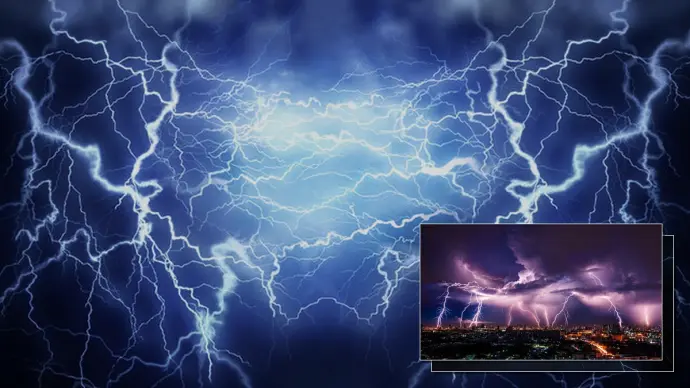
Lightning is a spectacular and powerful natural phenomenon, essentially a massive electrical discharge that occurs within the atmosphere. It is most commonly observed during thunderstorms, but can also manifest during volcanic eruptions, intense forest fires, and other atmospheric disturbances. This celestial spark momentarily equalizes electrical charges, creating a brilliant flash that illuminates the sky.
The fundamental cause of lightning lies in the buildup of opposing electrical charges. In the early stages of atmospheric electrical development, air acts as an insulator, preventing the flow of electricity between charged regions within a cloud, or between the cloud and the ground. However, when these charge differences become sufficiently large, the air's insulating capacity breaks down, leading to a rapid electrical discharge that we perceive as lightning.
Types of Lightning Discharges
Negative Discharge Lightning
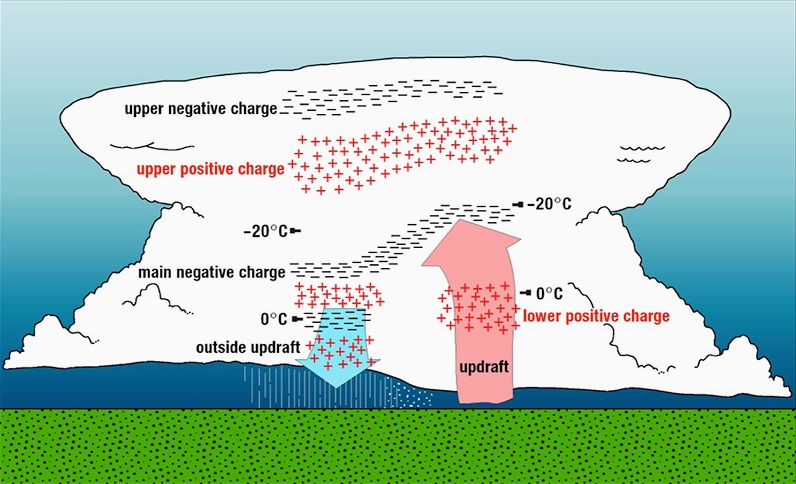
Cloud-to-ground lightning, specifically the negative discharge, is the most frequently experienced form. This occurs when a significant buildup of negative charges forms in the lower sections of a cumulonimbus cloud. This charge separation is often initiated by collisions between rising ice crystals and graupel (soft hail) within the cloud. These collisions result in positively charged ice crystals ascending and negatively charged graupel descending, concentrating negative charge at the cloud's base.
Beneath the storm, the ground becomes positively charged in response to the powerful negative charge overhead. Air, being a poor conductor, resists the electrical flow. To overcome this resistance, a pathway known as a stepped leader initiates from the cloud, typically negatively charged, and zigzags its way towards the ground. As this stepped leader approaches the ground, a positive streamer ascends from the ground to meet it, completing the conductive path. The subsequent rapid surge of negative charge moving upwards along this channel is what we observe as the bright flash of lightning, called a return stroke. Multiple return strokes can occur in rapid succession, though they happen too quickly for the human eye to discern individually.
Positive Discharge Lightning
A more perilous type of cloud-to-ground lightning is the positive discharge. Often associated with the phrase "a bolt from the blue," this form of lightning can strike the ground as far as 10 to 20 miles away from the parent storm. It originates in the upper regions of a storm, where positively charged ice crystals are prevalent. Due to the greater distance between the positive charge center and the ground, a much larger electrical charge buildup is required before the air's resistance is overcome. Although less common, positive discharge lightning is exceptionally dangerous due to its unpredictability and significantly greater power compared to negative discharges. The principles behind its formation are akin to negative discharges, but the charge polarity and origin differ.
The Science of Air Conductivity and Lightning Pathways
Air's inherent property as a poor electrical conductor plays a critical role in lightning phenomena. Even with immense electrical potential differences, a conductive channel must first be established. This pathway, the stepped leader, is formed through the ionization of air molecules. As the electric field strength intensifies, air molecules near the cloud gain electrons, becoming negatively charged and creating a more conductive path. This process is not uniform; variations in atmospheric conditions influence the path of the stepped leaders.
When a stepped leader nears the ground, the strong electric field induces a positive charge on the surface, leading to the formation of upward-streaming positive streamers. The meeting of a stepped leader and a positive streamer completes the circuit, allowing the massive flow of electrical current, the return stroke, to surge upwards. Understanding air conductivity is key to comprehending why lightning strikes occur where they do.
Extended Lightning Phenomena
Research has revealed that lightning discharges are not always confined to a single, fleeting flash. Some documented lightning events have spanned extraordinary distances, with the longest recorded discharges extending over 400 miles end-to-end. Furthermore, the duration of these discharges can also be prolonged, with some lasting for over 17 seconds from initiation to termination. These extended phenomena highlight the immense energy involved in atmospheric electrical events.
Beyond the typical visible bolts, other forms of lightning include sheet lightning, which is the diffuse illumination caused by lightning hidden behind clouds or precipitation, and heat lightning, often a misnomer for distant thunderstorms whose lightning is not directly visible but whose flashes are seen.
What Causes Thunder?
Thunder is the direct acoustic consequence of lightning. When a lightning channel is formed, the air within it is rapidly heated to temperatures reaching approximately 50,000 degrees Fahrenheit, far hotter than the surface of the sun. This extreme and instantaneous heating causes the air to expand explosively.
The resulting shock wave propagates outwards. Close to the lightning strike, this shock wave is intense, producing a sharp, tearing sound. As the sound wave travels further away, the pressure decreases, and the higher frequencies are absorbed by the air. This causes the thunder to diminish into a crackling sound and eventually a low-frequency rumble, audible up to 25 miles away.
The time delay between seeing a lightning flash and hearing thunder can be used to estimate the distance to the storm. Since light travels approximately one million times faster than sound, counting the seconds between the flash and the thunder provides a rough measure of distance. For every five seconds of delay, the lightning strike is approximately one mile away (or for every three seconds, about one kilometer).
Lightning Safety and Precautions
Given the immense power of lightning, safety is paramount during thunderstorms. Understanding the risks associated with phenomena like lightning mcqueen (a fictional character, not related to natural lightning) and the importance of rapid electrical discharge helps inform safety measures. While not directly applicable to natural lightning, the concept of rapid discharge is central to understanding its power. When thunder is heard, lightning is close enough to strike. Seeking immediate shelter indoors or in a hard-top vehicle is the safest course of action. Avoid open fields, isolated tall objects, and bodies of water. If caught outdoors with no shelter, minimize your profile by crouching low to the ground.
Technological advancements continue to evolve, and while not directly related to atmospheric phenomena, concepts like 'lightning charger' or 'lightning to 3.5mm' adapters refer to rapid charging technologies for electronic devices. These terms highlight the human fascination with speed and efficiency, mirroring the swiftness of natural lightning.
For those interested in further research, resources such as those provided by the National Severe Storms Laboratory (NSSL) offer in-depth insights into lightning research. The ability to predict and understand lightning is crucial for meteorology and public safety. The concept of 'lightning blox fruits' is a gaming term and has no relation to meteorological lightning.
The phenomenon of lightning, while awe-inspiring, carries significant risks. By understanding its causes, types, and associated dangers, we can better protect ourselves and appreciate the raw power of nature. Utilizing tools for 'lightning autofill' or 'lightning ai' are irrelevant to understanding natural lightning phenomena.
Comments (1)
Sarah Chen
15:53:44 21-07-2026Leave a Reply
Your email address will not be published. Required fields are marked *